
Premium Ceramic (Good)
Reliable Nano Ceramic protection. Available in 5%, 15%, 35%, 50% VLT.
- UV Protection
- 99%
- Heat Rejection
- Up to 46% IR
- Installer
- Polar Tint Certified
- Warranty
- Lifetime
Automotive window tint for Parker, Castle Rock, Lone Tree, Highlands Ranch, Castle Pines, Centennial, and southeast Denver Metro drivers — three climate-engineered ceramic grades, 99% UV across every tier, non-metallic and signal-friendly, fully Colorado window tint law compliant. Installed at 10232 Progress Ln by certified Polar Tint Parker North technicians — now open. Free quote, Lifetime Polar Tint Promise.
Every Polar Tint shop carries the same three Nano Ceramic grades. Same Lifetime Polar Tint Promise on all three. The right pick depends on how hot it gets, how much heat you want rejected, and how dark you want to go.
Reliable Nano Ceramic protection. Available in 5%, 15%, 35%, 50% VLT.
Enhanced heat rejection across five VLT options. 5%, 15%, 35%, 50%, 70% VLT.
Maximum heat rejection. The flagship for hot climates and daily commutes. 5%, 15%, 35%, 50%, 70% VLT.
Ceramic film rejects infrared heat at the glass. Black-leather steering wheel and seats stop scorching in the August parking lot.
Altitude UV at 5,800+ ft is meaningfully stronger than at sea level. Skin Cancer Foundation Recommended film blocks it before it reaches you.
Front Range snow-glare in winter and low-angle Colorado sun in summer disappear. Safer driving on I-25, E-470, and Parker Road.
Non-metallic Nano Ceramic. No cell, GPS, garage-door, toll-transponder, or satellite-radio interference. Ever.
Dashboards stop cracking. Leather stops fading. Resale value stays where it should be.
Film and install both covered for the life of the vehicle. Transferable on sale. Honored at any Polar Tint location.
Polar Tint Parker North installs Nano Ceramic automotive window tint in three Colorado-tuned grades. Premium Ceramic (Good) rejects 46% of infrared heat with 99% UV — the daily-driver baseline that beats every dyed and carbon film on the market. Ceramic Plus (Better) rejects 80% IR with 99% UV — the right pick for commuters spending an hour a day on I-25 or E-470.
Ceramic Ultimate Plus (Best) is the 98% IR flagship — the highest heat rejection in the Polar Tint catalog, engineered for black interiors, leased exotics, family SUVs left in summer parking lots, and anyone who wants the cabin to feel air-conditioned the moment the door closes. All three are signal-friendly, Colorado window tint law compliant, and backed by the Lifetime Polar Tint Promise. Free quote — call (720) 954-2853.
Polar Tint Parker North installs three Nano Ceramic grades on cars, trucks, SUVs, EVs, and exotics. Every grade is non-metallic, blocks 99% of UV, and is fully compliant with Colorado’s 27% VLT front/rear-side rule. The only difference is how aggressively the film blocks infrared heat — and how cool the cabin feels in July at 5,800 feet of altitude.
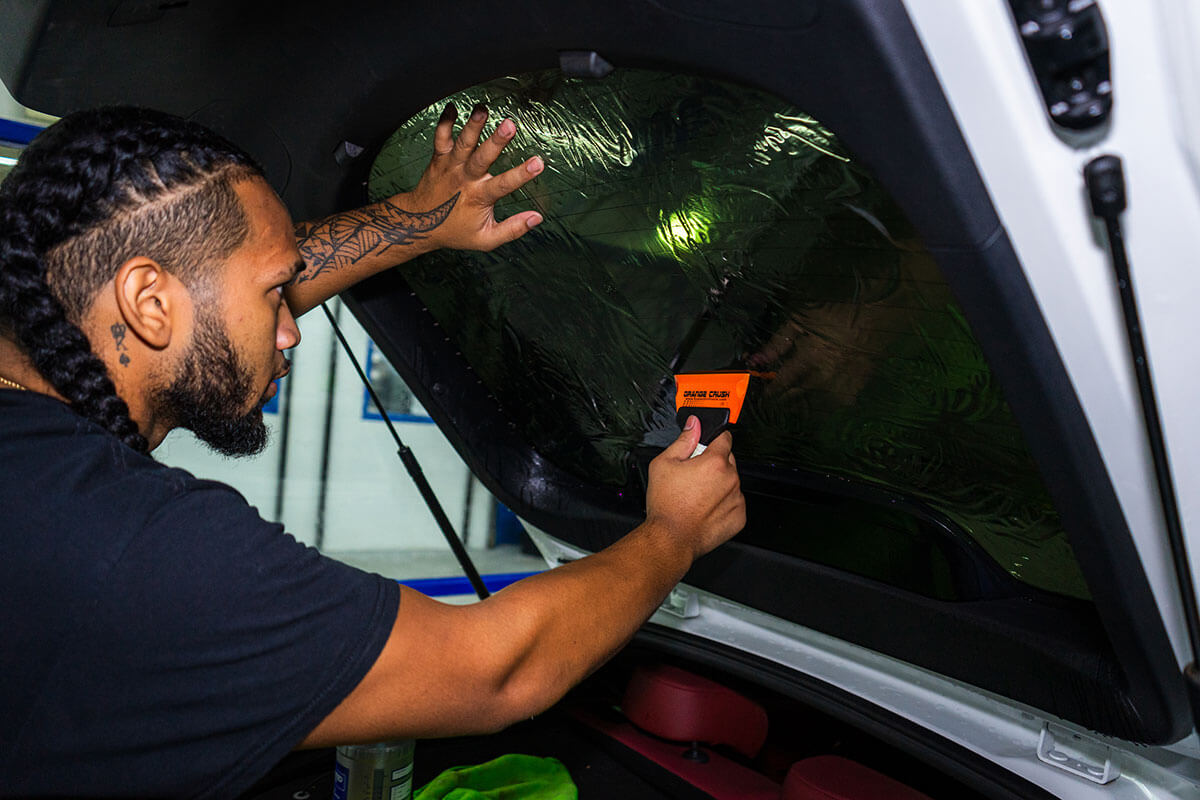
Premium Ceramic is the entry-tier Nano Ceramic window tint in the Polar Tint catalog, and on its worst day it outperforms every dyed or carbon film on the market. It rejects 46% of infrared heat at the glass, blocks 99% of UV, and stays optically clear for the life of the vehicle.
There’s no purple-fade like cheap dyed film, no signal interference like old metallic film, and no bubbling or peeling in a Parker summer parking lot. It’s the right call if you commute under an hour a day on I-25 or Parker Road, garage the car most nights, and want a meaningful upgrade over factory glass without going to the very top of the lineup.
On a 95°F July afternoon in the Park Meadows lot, a Premium Ceramic cabin is meaningfully cooler than a factory-glass cabin sitting in the same row. The steering wheel doesn’t burn. The leather isn’t skin-sticking hot.
The AC catches up in a couple of blocks instead of fighting all the way home. And because Premium Ceramic blocks 99% of UV, the dashboard plastic stops cracking, the leather stops fading, and the resale value of your vehicle holds where it should.
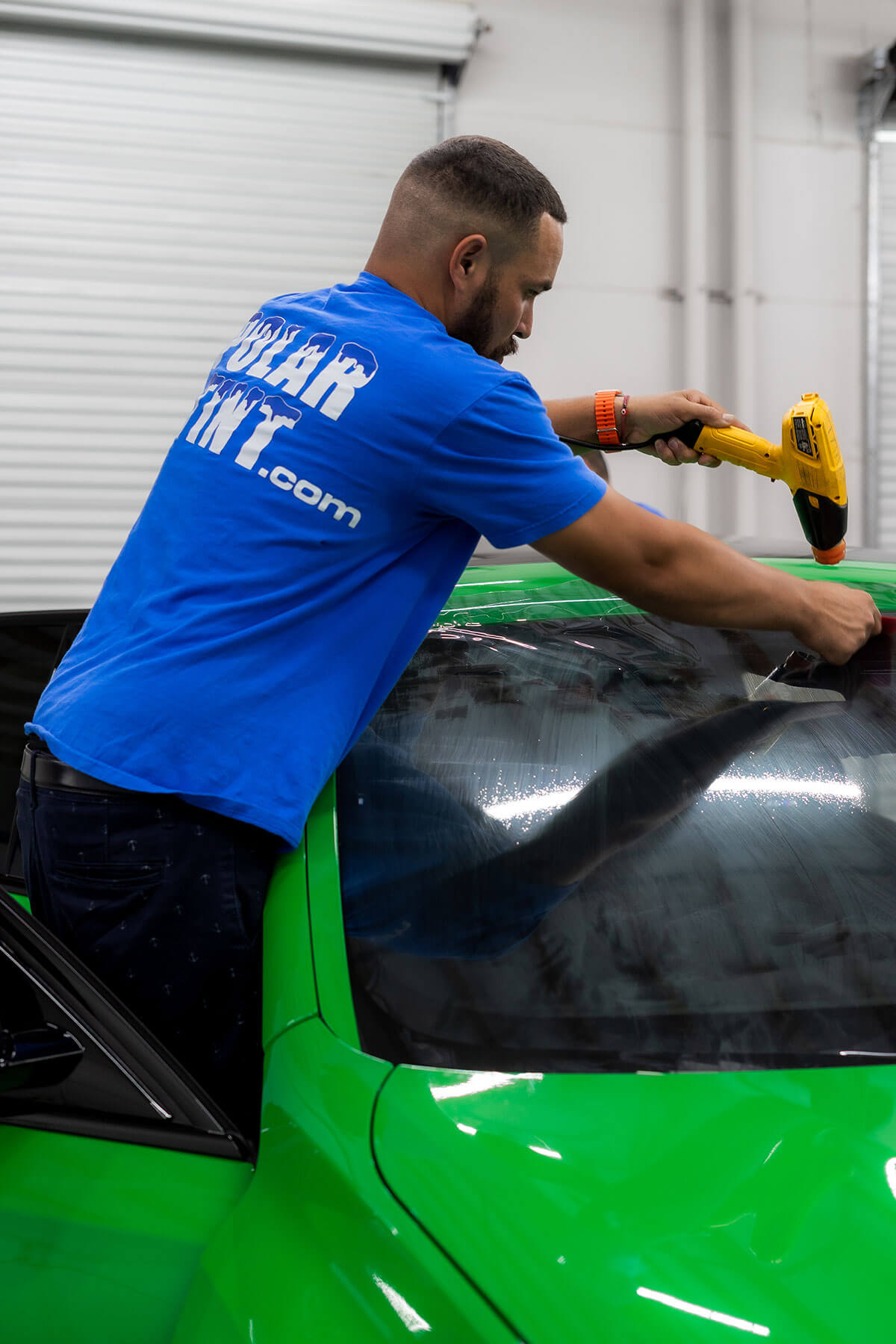
Ceramic Plus is the second of the three Nano Ceramic grades, and it’s where most Parker commuters and ski-trip families settle in. It rejects 80% of infrared heat — nearly double Premium Ceramic — while keeping the same 99% UV block, the same non-metallic signal-friendly construction, and the same Colorado-law-compliant VLT options.
If you spend more than 45 minutes a day in the car, drive west on I-70 to ski country on weekends, or park outside at work, this is the tier where the math really starts to work in your favor.
The practical difference at 80% IR is dramatic. A black-on-black SUV that used to be unusable at 4pm becomes comfortable inside thirty seconds of starting the AC. A long Sunday descent down I-70 from Loveland stops baking the driver-side door.
The kids in the back row stop melting. And when you finally park the car in the Parker garage at the end of a 95° July day, the interior plastic isn’t cooked, the screen isn’t hot to the touch, and the leather hasn’t aged a year overnight.
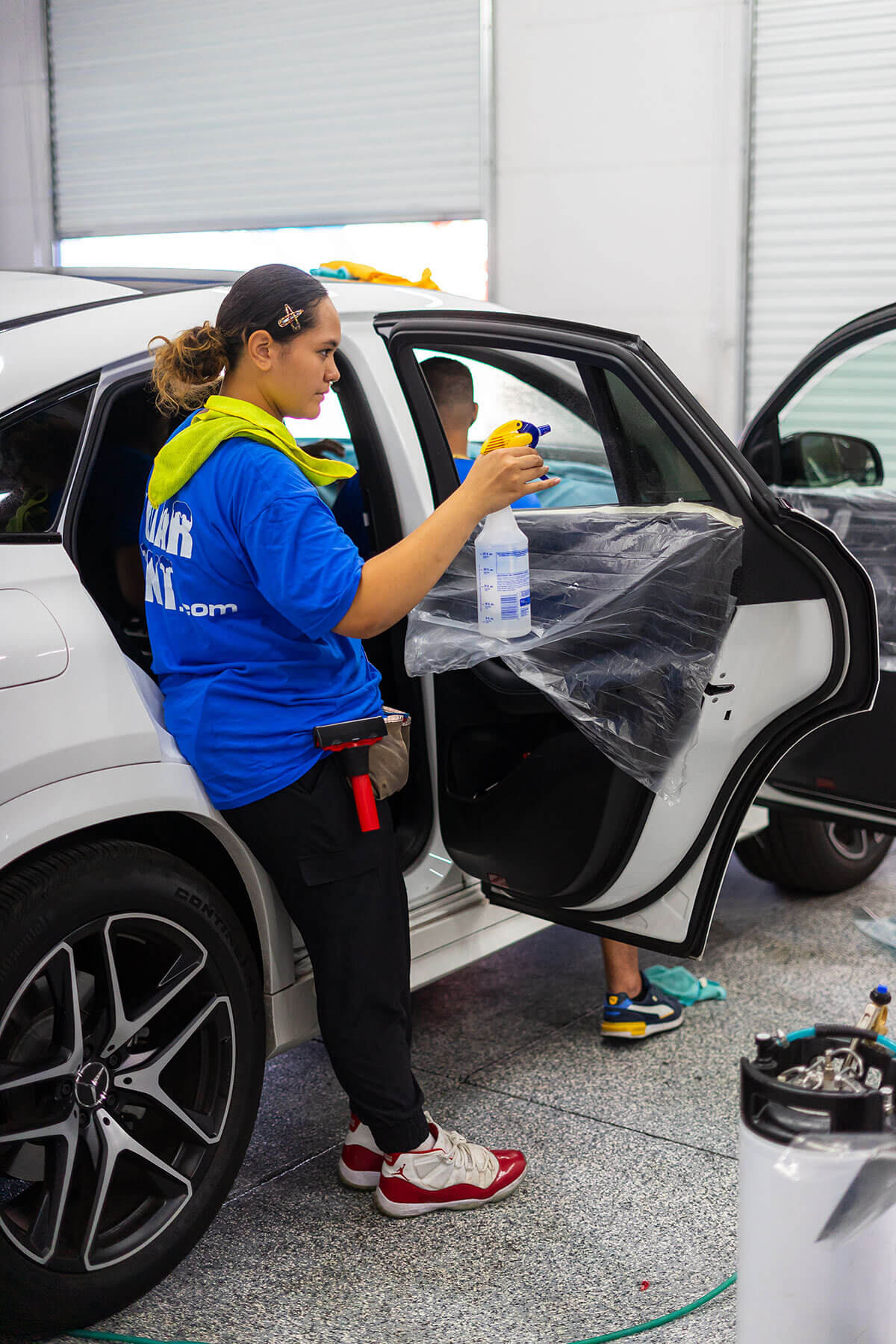
Ceramic Ultimate Plus is the top of the Polar Tint Nano Ceramic catalog and the highest-rejection automotive window film we install. It blocks 98% of infrared heat at the glass — the highest IR rejection number in the lineup — while staying optically pure, signal-friendly, and Colorado-law compliant in approved VLT shades.
This is the tier we install on leased exotics, black-on-black luxury SUVs, family vehicles that live in the August sun, EVs where every degree of cabin cooling extends range, and any Parker driver who wants the cabin to feel air-conditioned the second the door closes.
The difference between 80% and 98% IR is the difference between “comfortable in a few minutes” and “already comfortable.” A black Cybertruck, a Model X, a Rivian R1S, a Range Rover, an Escalade — vehicles that absorb heat aggressively and bake their interiors in the high-altitude Colorado sun — finally behave the way you’d expect a premium cabin to behave.
The leather doesn’t age twice as fast as it should. The dashboard doesn’t crack. The kids in the back row stop asking when the AC will catch up. Driving electric? See our guide to Tesla and EV window tint in Parker for why heat rejection eases the cabin cooling load on a battery.
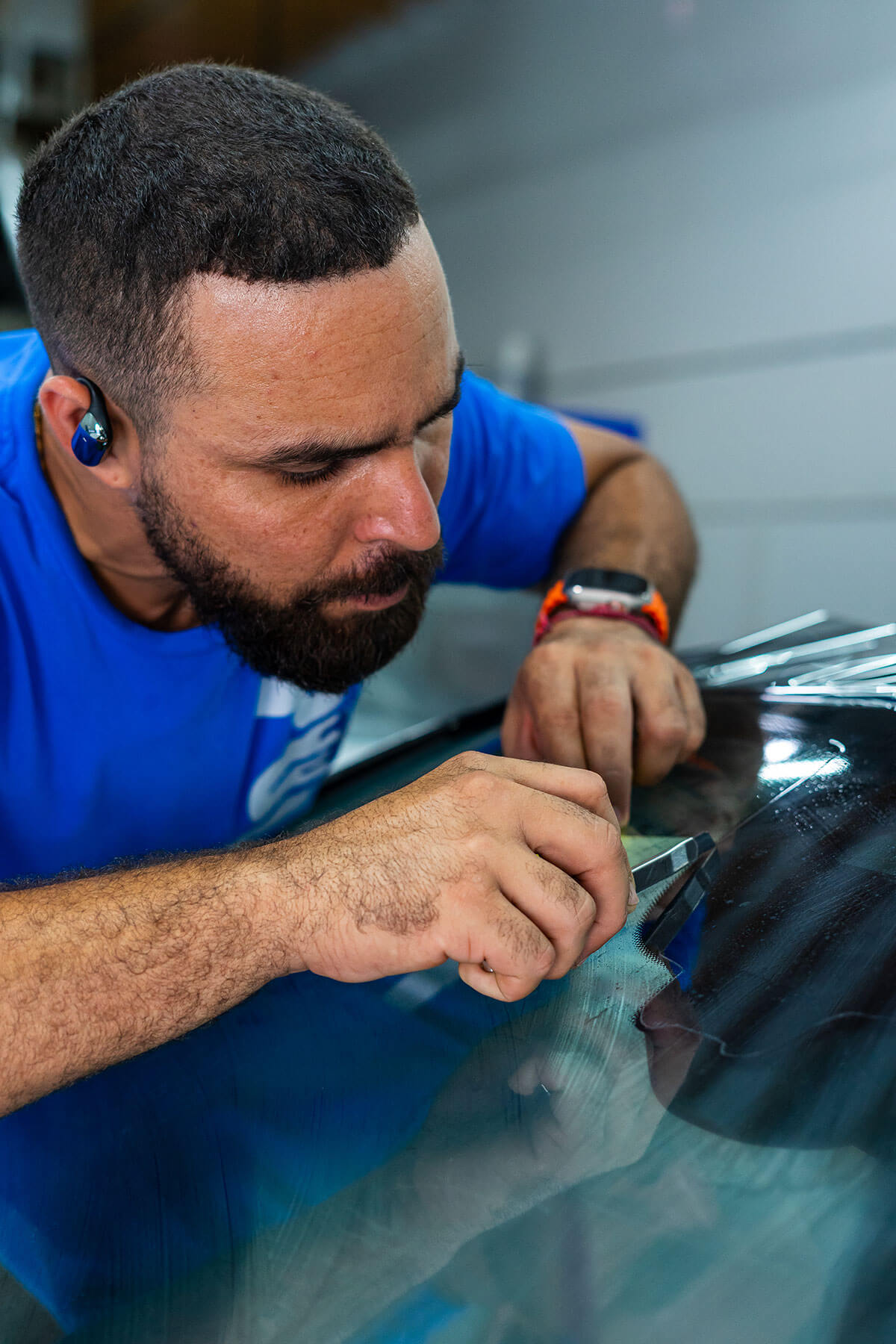
Polar Tint Parker North only installs Nano Ceramic. We don’t stock dyed film, we don’t stock carbon, and we don’t stock metallic. Here’s why that’s the right call in Colorado. Dyed film goes purple inside two summers in the Front Range sun — the dye breaks down under altitude UV and the windows start looking like cheap aftermarket.
Carbon film doesn’t fade as fast, but it has noticeably weaker infrared rejection — the cabin stays hot. Metallic film blocks heat well, but the metal layer interferes with cell signal, GPS, garage-door openers, toll transponders, and satellite radio — a non-starter for any modern vehicle, and a hard pass on any EV.
Nano Ceramic gives you the best of every world: maximum infrared rejection, no signal interference, no fading or purpling, and optical clarity that lasts the life of the vehicle.
It’s why the entire Polar Tint network — including Parker North — runs ceramic-only and backs every install with the Lifetime Polar Tint Promise. If the film fails, we replace it. If the install fails, we redo it. Honored at any Polar Tint location, transferable on sale.
Every Polar Tint Parker North installer is certified and manufacturer-trained on the same Nano Ceramic playbook every Polar Tint location runs. No off-the-street installers on your vehicle.
Film and install both covered for the life of the vehicle — no purple-fade, no bubbling, no peeling, no adhesive failure. Transferable on resale. Honored at every Polar Tint location nationwide.
Bring a written quote from any licensed local Parker tint shop for the same ceramic tier and same coverage. Polar Tint Parker North matches it. The Lifetime Polar Tint Promise still applies on top.
10232 Progress Ln — serving Parker, Parker North, Castle Rock, Castle Pines, Lone Tree, Highlands Ranch, Centennial, Stonegate, Pinery, Stroh Ranch, Idyllwilde, and southeast Denver Metro. Drive in, get a written quote, install on your timeline.
The same certified team that tints your vehicle installs window film on Parker homes and offices too — on-site, not in the shop. If you came here for automotive tint, here’s the rest of what Polar Tint Parker North covers.
Heat-rejection, security (anti-shatter), privacy/decorative, and low-E insulating film for Parker-area homes — installed on-site with a free in-home consult and the Lifetime Polar Tint Promise. See residential window film.
Solar, security/anti-shatter, anti-graffiti, and decorative/privacy frost film for Parker-area offices, retail, and storefronts — installed on-site, with single-account-manager multi-site rollouts. See commercial window film.
Polar Tint Parker North quotes automotive ceramic window tint in person, at the shop or over the phone. We walk the vehicle with you, recommend the right ceramic grade, and give you a written number before you sign anything.
Call (720) 954-2853 or send a message to book a quote at a time that works for you.
A certified Polar Tint Parker North installer walks every window of your vehicle with you, talks through the three ceramic grades, and recommends the right tier for the way you drive in Colorado.
You get a full written quote, scope, install date, and warranty terms. You decide. The Lifetime Polar Tint Promise applies to whatever you choose.
Want to see what happens in the bay? Read the full window tint installation process — glass prep, film fitting, quality checks, and cure-time care. Have old film to take off first? See the window tint removal process.
Short version: a "98% IR rejection" number is not the same as blocking 98% of the sun's heat. Here is the honest breakdown so you can compare ceramic films like a pro.
The sunlight hitting your car on the Front Range is roughly 53% infrared (IR — the radiant heat you feel on your arm), 44% visible light, and 3% ultraviolet (UV). Three different numbers describe three different things, and tint marketing loves to blur them.
VLT (Visible Light Transmission) is only how dark the film looks — it says nothing about heat. UV rejection is the share of ultraviolet blocked; every Polar Tint ceramic grade blocks 99% of UV, which matters a lot here because thinner air at roughly 5,800 feet lets noticeably more UV through than at sea level.
IR rejection is the share of infrared stopped at the measured wavelengths — Polar Tint grades hit up to 46%, 80%, and 98%. But IR is only part of the sun's energy, so that headline can't mean "98% of all heat."
The one number that captures the whole picture is TSER — Total Solar Energy Rejected — the percentage of the entire solar spectrum (UV + visible + IR together) a film rejects. Because it includes everything, TSER is always lower than the IR figure, and it is the only true apples-to-apples heat comparison between films.
We don't slap an inflated TSER on a banner — at your free Polar Tint Parker North estimate we'll give you the exact TSER for the grade and shade you pick, so your choice fits Parker's high-altitude sun and big day-to-night temperature swings.
Colorado allows 27% VLT on the front side windows and 27% VLT on the back side windows, 27% VLT on the rear window (darker only if the front sides and windshield allow 70%+), and a non-reflective tint strip down to the AS-1 line on the windshield. Polar Tint Parker North installs Colorado-legal shades on every vehicle, so your tint clears the state's legal limit while still cutting glare and heat. (Colorado's tint statute (C.R.S. 42-4-227) contains no medical-exemption pathway — the 27% VLT limit applies to every driver.)
Here's what makes Parker different from a sea-level city. The Front Range sits at high elevation, so there's less atmosphere overhead to absorb solar radiation. That means a stronger UV and solar load reaching your glass — and your skin and interior — than a car parked at sea level would ever see. Tint that's merely "legal" is not the same as tint that's built to handle that load.
That's why Polar Tint installs non-metallic Nano Ceramic film only, in three grades:
Every grade blocks 99% of UV rays, and because the film is non-metallic, it won't interfere with phone, GPS, or keyless signals. Every install is backed by the Lifetime Polar Tint Promise, which transfers if you sell the vehicle. Pricing is quoted locally — ask Polar Tint Parker North for a free estimate.
Quick answer: Colorado sets the front side windows at 27% VLT and the back side windows at 27% VLT, requires 27% VLT on the rear window (darker only if the front sides and windshield allow 70%+), and allows a non-reflective tint strip down to the AS-1 line on the windshield.
Polar Tint Parker North installs Colorado-legal shades on every job and shows you exactly what's allowed for your vehicle before any film goes on.
If a brighter cabin isn't an option for you medically, Colorado's tint statute (C.R.S. 42-4-227) contains no medical-exemption pathway — the 27% VLT limit applies to every driver, and there is no permit to apply for.
If sunlight is a medical concern, we'll help you pick the darkest Colorado-legal grade for your build, and every tier still blocks 99% of UV. Tint rules change, so it's always worth verifying current law with the Colorado DMV before installation.
Here's the part most Parker drivers miss. Front Range elevation means a thinner atmosphere and a stronger solar load than you'd feel at sea level, so the sun coming through legal-shade glass still carries real UV and infrared heat. That's why the shade percentage isn't the whole story up here.
Every Polar Tint film blocks 99% of UV and rejects infrared heat, so even a light, fully Colorado-legal tint protects your skin and interior and keeps the cabin cooler. You don't have to go dark to get serious protection at altitude.
Polar Tint Parker North installs Nano Ceramic automotive window tint, ceramic window film, IR-rejecting tint, signal-friendly tint, Colorado-law-compliant tint, and Skin Cancer Foundation Recommended UV-blocking tint on cars, trucks, SUVs, EVs, and exotics across Parker, Parker North, Castle Rock, Castle Pines, Lone Tree, Highlands Ranch, Centennial, Stonegate, Pinery, Cottonwood, Stroh Ranch, Idyllwilde, Cherry Creek, Aurora South, southeast Denver Metro, and the Front Range corridor.
The shop based at 10232 Progress Ln serves I-25 commuters, E-470 toll-loop drivers, I-70 weekend skiers, EV daily-drivers, family SUVs, leased exotics, and work trucks. Free quote. Lifetime Polar Tint Promise. Call (720) 954-2853.
Keyword cluster: Parker window tint · Parker CO car tint · ceramic window tint Parker · Nano Ceramic tint Parker Colorado · window tint Castle Rock · window tint Lone Tree · window tint Highlands Ranch · window tint Castle Pines · window tint Centennial · window tint Cherry Creek · Tesla window tint Parker · Rivian window tint Parker · ceramic tint near me Parker · Colorado window tint law · legal window tint Colorado · 27 VLT Colorado · high-altitude UV window tint · Front Range window tint installer.
Call (720) 954-2853, send a message, or fill out the form. The Polar Tint Parker North team responds same business day.
Polar Tint Parker North books ceramic tint quotes by phone, message, or walk-in at 10232 Progress Ln. Call (720) 954-2853 or request a quote online — same-business-day response.